Deep Learning
Unlocking the universe's secrets, one neural network layer at a time. 🧠✨
Featured partners and sponsors
New advertisers get $25 in ad credits
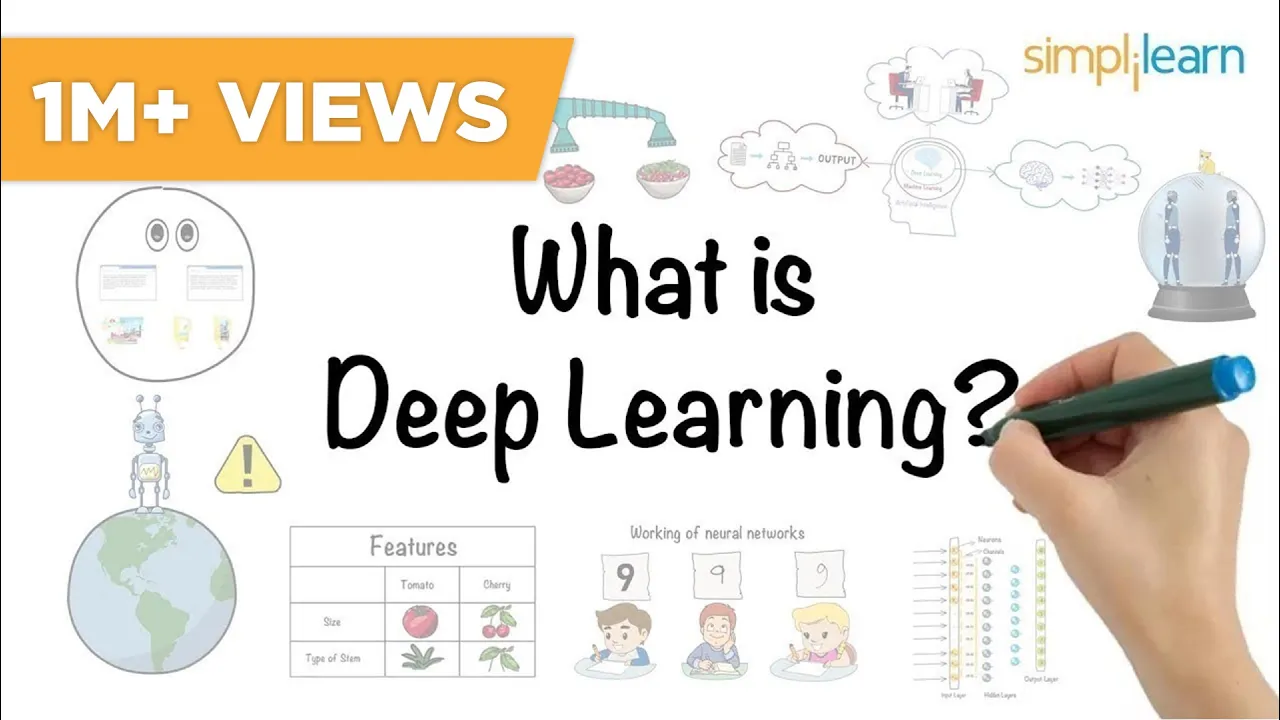
Deep Learning | What is Deep Learning? | Deep Learning Tutorial For Beginners | 2026 | Simplilearn
Deep Learning Crash Course for Beginners
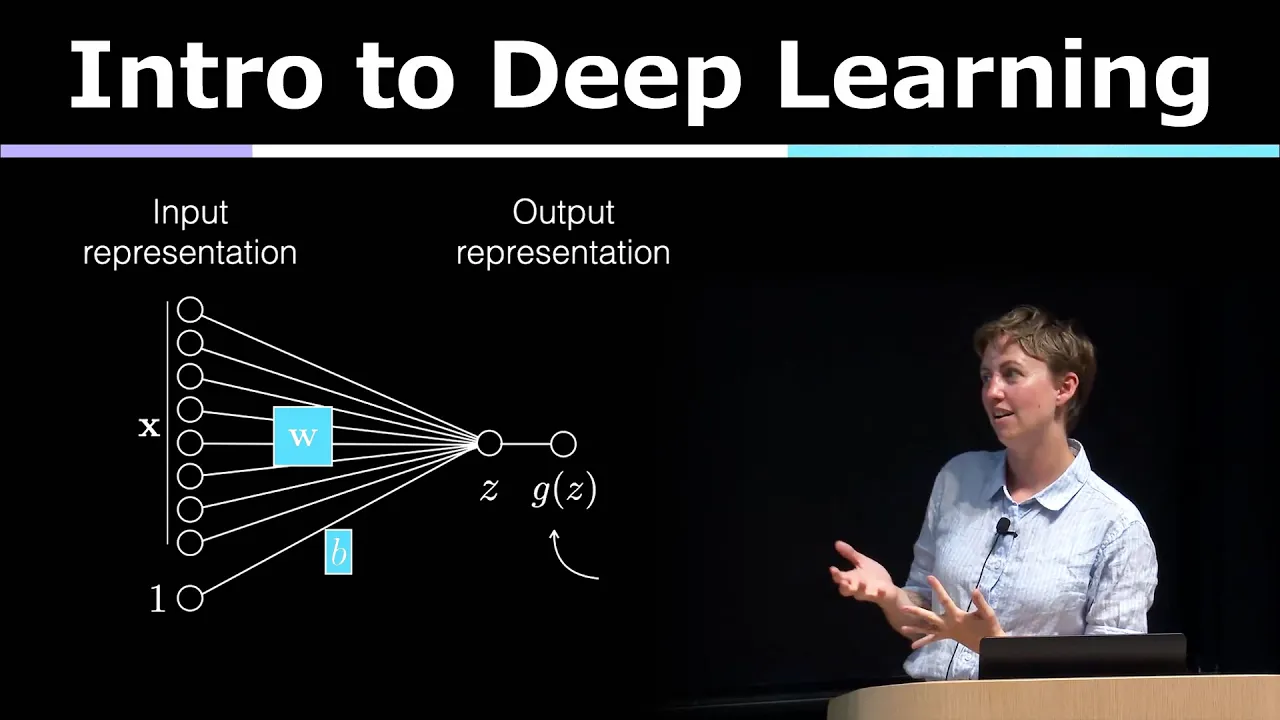
Lec 01. Introduction to Deep Learning
ever wondered how google translates an entire web page to a different language in a matter of seconds or your phone gallery group's images based on their location all of this is a product of deep learning but what exactly is deep learning deep learning is a subset of machine learning which in turn is a subset of artificial intelligence artificial intelligence is a technique that enables a machine to mimic human behavior machine learning is a technique to achieve ai through algorithms trained with data and finally deep learning is a type of machine learning inspired by the structure of the human brain in terms of deep learning this structure is called an artificial neural network let's understand deep learning better and how it's different from machine learning say we create a machine that could differentiate between tomatoes and cherries if done using machine learning we'd have to tell the machine the features based on which the two can be differentiated these features could be the size and the type of stim on them with deep learning on the other hand the features are picked out by the neural network without human intervention of course that kind of independence comes at the cost of having a much higher volume of data to train our machine now let's dive into the working of neural networks here we have three students each of them write down the digit 9 on a piece of paper notably they don't all write it identically the human brain can easily recognize the digits but what if a computer had to recognize them that's where deep learning comes in here's a neural network trained to identify handwritten digits each number is present as an image of 28 times 28 pixels now that amounts to a total of 784 pixels neurons the core entity of a neural network is where the information processing takes place each of the 784 pixels is fed to a neuron in the first layer of our neural network this forms the input layer on the other end we have the output layer with each neuron representi...
⚡ THE VIBE
✨Deep Learning is a revolutionary subset of [Machine Learning](machine-learning) that employs multi-layered neural networks to automatically learn complex patterns from vast amounts of data, driving breakthroughs from self-driving cars to medical diagnostics. It's the engine behind many of the most exciting AI advancements of our era! 🚀
§1What is Deep Learning? The Brain-Inspired Revolution 🧠
Imagine teaching a computer to recognize a cat, not by giving it a list of rules (like 'has whiskers, pointy ears, four legs'), but by showing it millions of cat pictures until it just knows. That's the essence of Deep Learning. At its core, it's a class of Machine Learning algorithms that uses artificial neural networks with multiple layers (hence 'deep') to learn representations of data with multiple levels of abstraction. These networks are loosely inspired by the structure and function of the human brain, featuring interconnected 'neurons' that process and transmit information. Unlike traditional machine learning, deep learning excels at automatically extracting relevant features from raw data, eliminating the need for manual feature engineering. It's like giving the computer super-sight to find hidden patterns! 🌟
§2The Genesis: From Perceptrons to GPUs 💡
The roots of deep learning stretch back to the 1940s with the first models of artificial neurons, and the 1950s saw the development of the perceptron. However, these early models were limited. The real spark ignited in the 1980s with the re-emergence of backpropagation, an algorithm that allowed neural networks to learn from errors by adjusting the weights of their connections. Yet, progress was slow due to computational limitations and the 'vanishing gradient problem'. The 2000s brought a perfect storm: massive datasets (think the internet!), powerful new algorithms, and crucially, the advent of GPUs (Graphics Processing Units). GPUs, originally designed for video games, turned out to be perfect for the parallel computations neural networks require. By 2012, with breakthroughs like AlexNet in the ImageNet competition, deep learning exploded onto the scene, proving its unparalleled ability to tackle complex tasks. It was a true 'aha!' moment for AI. 🤯
§3How It Works: Layers of Abstraction 🏗️
A deep neural network consists of an input layer, several hidden layers, and an output layer. When data (e.g., an image) enters the input layer, it passes through each hidden layer. Each 'neuron' in a layer performs a simple calculation, transforming the input it receives and passing it on. Crucially, each layer learns to detect different features. For an image, the first layers might detect edges and simple shapes, while deeper layers combine these to recognize more complex patterns like eyes, noses, or entire objects. This hierarchical learning allows the network to build increasingly abstract representations of the data. The network's 'knowledge' is stored in the weights (strength of connections between neurons) and biases (thresholds for activation). During training, the network is fed labeled data, and an optimization algorithm (like stochastic gradient descent) adjusts these weights and biases to minimize prediction errors. It's an iterative process of trial and error, constantly refining its understanding. ✨
§4Impact & Applications: Reshaping Our World 🌍
Deep learning has profoundly reshaped countless industries and aspects of daily life. Its applications are vast and ever-expanding:
- Computer Vision: From facial recognition and self-driving cars (Autonomous Vehicles) to medical image analysis (detecting tumors in X-rays). 🚗👁️
- Natural Language Processing (NLP): Powering language translation (Google Translate), chatbots, sentiment analysis, and the large language models (LLMs) that define the current AI landscape. 🗣️✍️
- Speech Recognition: The technology behind voice assistants like Siri and Alexa. 🎙️
- Recommendation Systems: Guiding your choices on Netflix, Amazon, and Spotify. 🎶🛍️
- Drug Discovery: Accelerating the identification of new compounds and therapies. 🔬
- Robotics: Enabling robots to perceive and interact with their environment more intelligently. 🤖 It's not just about automation; it's about augmenting human capabilities and solving problems once thought intractable. The impact is truly game-changing. 🚀
§5Challenges & The Road Ahead 🚧
Despite its triumphs, deep learning faces significant challenges. One major hurdle is its data hunger; these models often require enormous datasets to perform well, which can be expensive and time-consuming to acquire and label. Another key issue is interpretability or the 'black box problem' – it can be difficult to understand why a deep learning model made a particular decision, which is critical in sensitive applications like healthcare or finance. Concerns around bias in training data leading to unfair or discriminatory outcomes are also paramount. The field is actively researching solutions like explainable AI (XAI), few-shot learning, and more energy-efficient models. The future promises even more sophisticated architectures, hybrid AI approaches combining deep learning with symbolic AI, and a deeper understanding of intelligence itself. The journey is far from over! 🌌